On this page
You lean on the wall by the front entry and it gives a little. Or there’s a dent in the band around a window that a hard wall would never take. That soft, hollow feel is a clue the wall isn’t regular stucco at all. It’s EIFS, and EIFS repair calls for different materials than cement stucco.
Rocket Stucco cuts out damaged EIFS and foam trim, rebuilds it with matching layers, and then paints or seals it so the repair blends in. We’re licensed and insured, and the estimate is written and costs nothing.
What is EIFS, and how is it different from hard-coat stucco?
The letters EIFS are short for exterior insulation and finish system. Many people call it synthetic stucco, and you’ll often hear it called Dryvit too, after one of the product names. Instead of a thick cement coat on block or lath, EIFS is a layer of foam board fixed to the wall, covered with fiberglass mesh, a thin base coat and a colored finish coat. It’s light, it insulates and it’s easy to shape, which is why so many decorative bands and window surrounds are made from it.
Hard-coat stucco is stiff and solid. EIFS is softer and sounds hollow when you knock on it. That difference matters, because patching EIFS with cement stucco makes a hard spot that cracks around its edges.
Where do Space Coast homes use EIFS and foam trim?
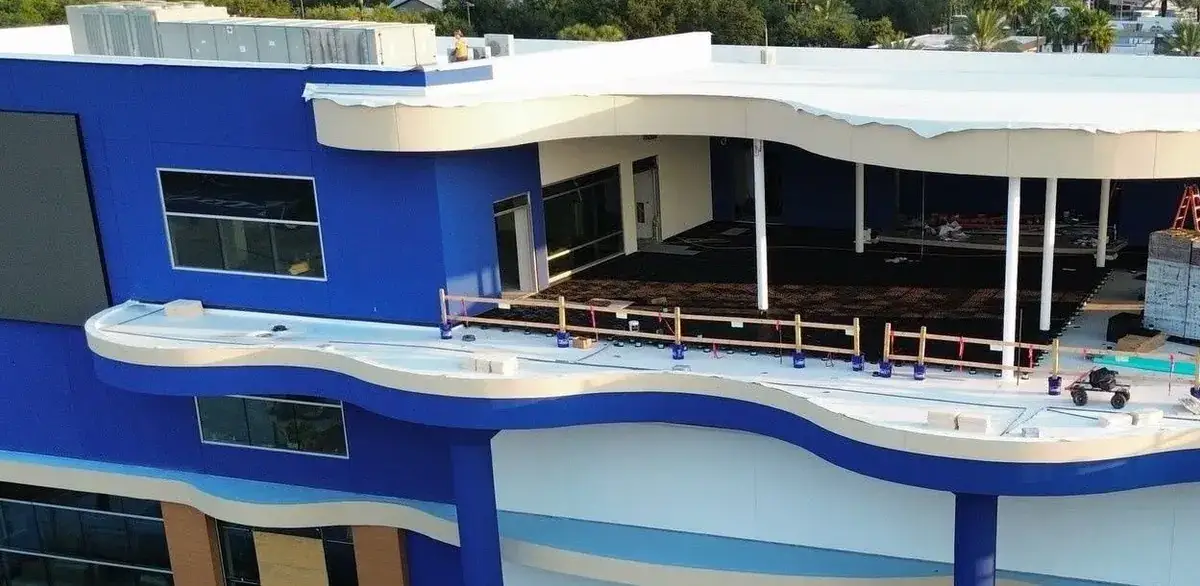
On many block homes around Brevard, the main walls are hard-coat stucco and the details are foam. Window and door surrounds, the bands that wrap the house between floors, keystones over arches, column caps and cornices are often foam trim coated to look like stucco. Some newer homes, condos and commercial buildings are covered in EIFS from top to bottom.
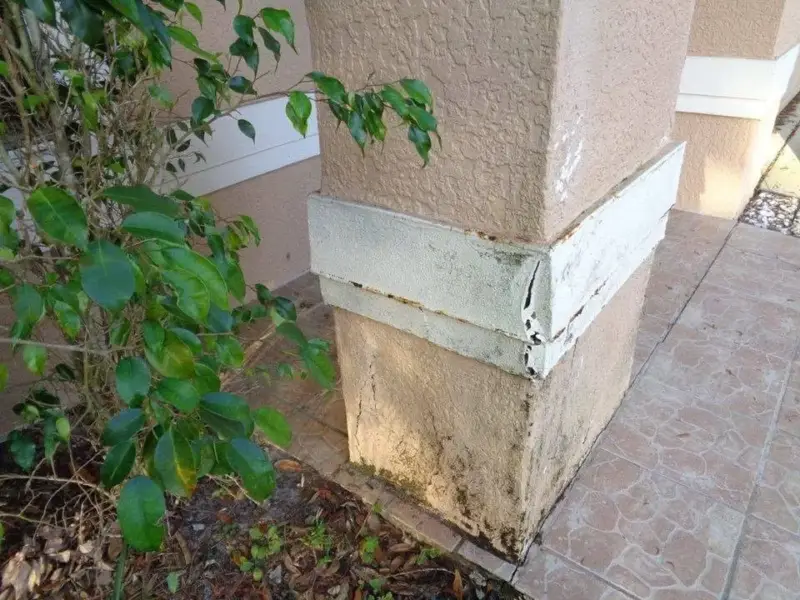
Foam shapes are popular because they’re light and quick to install, and they give a plain block house the look of carved stone. The downside is that the foam is soft. A ladder leaned against a band, a bike handlebar or a palm frond in a storm can dent it, and every dent is a small opening for rain.
What do we check on an EIFS wall before quoting?
- Dents, punctures and gouges from ladders, mowers and flying debris.
- Cracks along trim edges and where foam meets the stucco wall.
- Gaps in the sealant joints around windows, doors and light fixtures.
- Soft spots, bulges or stains that hint at water behind the foam.
- The finish texture and color, so the repair can match.
We press and tap along anything that looks suspect. Foam that feels mushy or pulls away usually means water has reached the wall behind it.
Why does water behind EIFS matter so much?
Older EIFS walls were built as barrier systems. The idea was that the outer coat kept all water out, with no drainage path behind the foam. When water slipped past a crack or a failed sealant joint, it had no easy way back out and could sit against the wall for years. Newer systems are usually built with a drainage layer that lets water escape. Either way, the sealant joints and the finish coat are the first line of defense, so keeping them tight is most of the battle.
Wet foam turns the job into a water damage repair before anything else, and the steps for opening and drying a wall are on our stucco water damage repair page.
How is EIFS repair done, step by step?
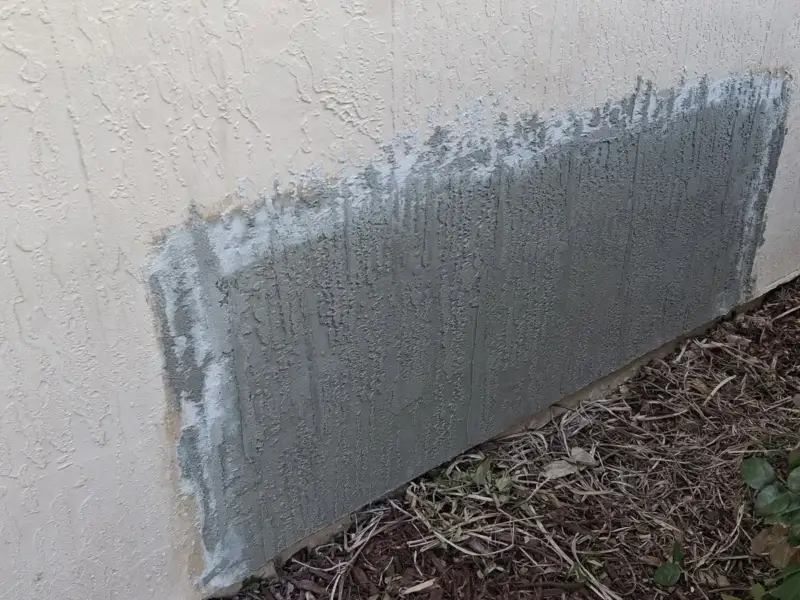
- Cut out the damage. We cut a clean square around the dent or crack, down through the finish, mesh and foam.
- Look at the wall behind. If the sheathing or block is wet, it’s dried and fixed before anything goes back on.
- Fit new foam. A matching piece of foam board is glued in and rasped level with the surrounding surface.
- Mesh and base coat. New mesh is set into base coat and lapped over the old mesh, so the patch ties into the wall.
- Finish coat. The textured finish is applied to match the old one.
- Seal the joints. Fresh sealant goes around windows, doors and other openings nearby.
- Paint or seal. The repaired area, or the full wall, is coated so the color matches and the surface sheds rain.
Can broken foam trim and bands be rebuilt?
Yes. Broken window surrounds, chipped bands and cracked column caps can be rebuilt with new foam shapes cut to the old profile, then meshed, coated and painted. Salt air near the lagoon and the beach is hard on the thin finish coat over foam, so trim on the sides that face the water tends to crack first. Our painting and sealing page explains the coatings that help protect it.
How do I keep EIFS in good shape?
- Look over the sealant joints around windows and doors once a year, and reseal any that have cracked or pulled away.
- Keep the bottom edge of the EIFS clear of soil and mulch.
- Fix dents and punctures while they’re small, before rain gets into the foam.
- Skip high-pressure washing, since it can tear the finish.
- Keep sprinklers aimed away from the walls.
What will EIFS repair cost?
EIFS repair is priced on the size of the damage, what’s behind it and how much painting the match needs. A small dent costs far less than a wet section of wall. Your written estimate is free and lists each repair.
Request a free quote, or read more about how we work as a stucco contractor for Brevard homeowners. For hard-coat walls, head to our main stucco repair page instead.
Last updated